Why WebP is the Future of Web Images
Discover why WebP has become the standard for web images, offering superior compression to JPEG and PNG with broad browser support.
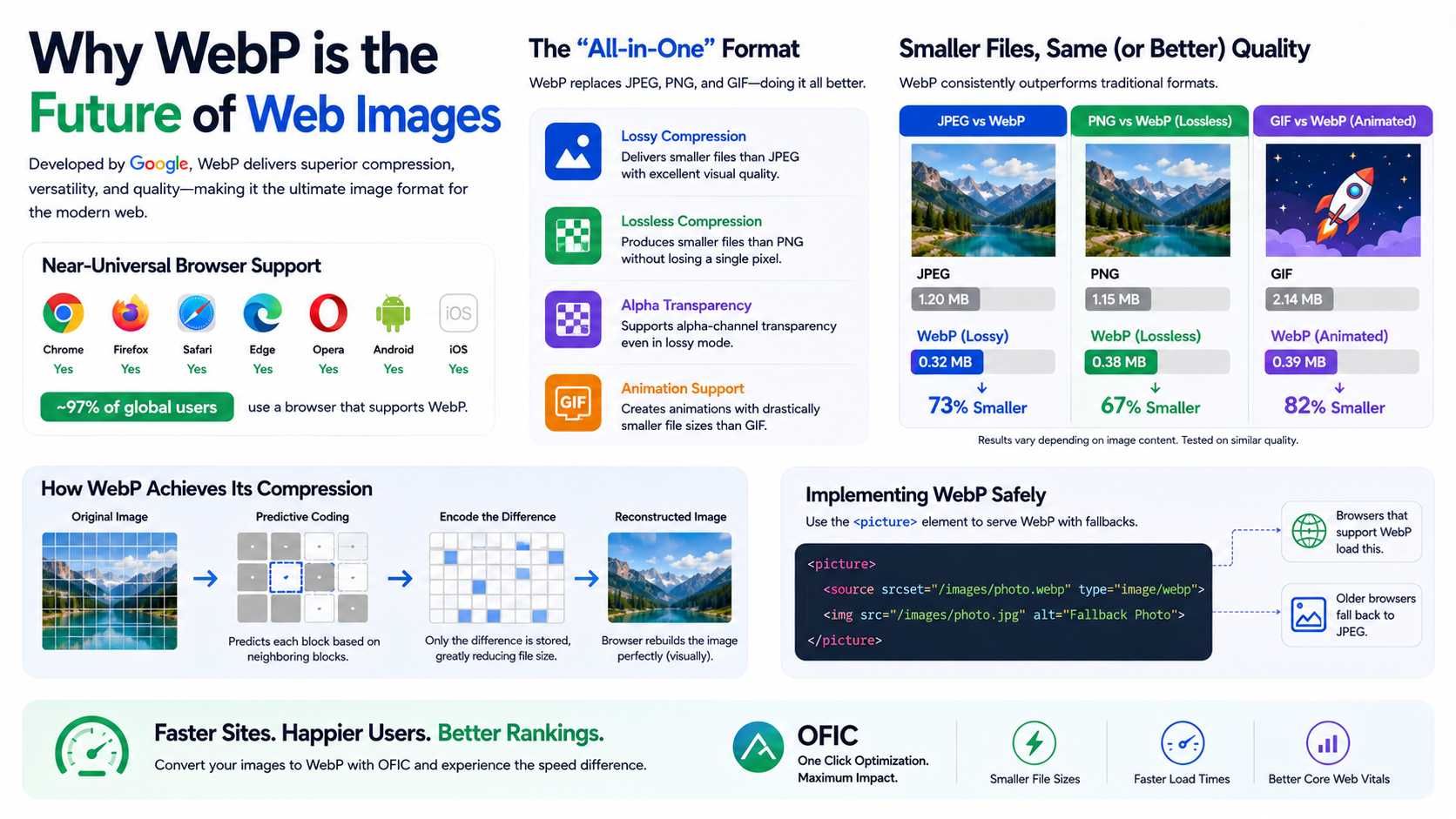
Developed by Google over a decade ago, WebP was designed to be the ultimate image format for the internet. For years, its adoption was slowed by a lack of support in Safari and older versions of Edge. Today, however, WebP enjoys near-universal browser support, making it the undisputed champion of web images.
The "All-in-One" Format
Historically, developers had to juggle multiple formats based on their needs: JPEG for photos, PNG for transparency, and GIF for animations. WebP replaces all three.
- It supports Lossy compression that beats JPEG.
- It supports Lossless compression that beats PNG.
- It supports Alpha-channel transparency (even in lossy mode!).
- It supports animation, offering drastically smaller file sizes than legacy GIFs.
How WebP Achieves Its Compression
WebP lossy compression uses predictive coding. It breaks the image down into macroblocks and predicts the contents of a block based on its neighboring blocks. It then only encodes the mathematical difference between the prediction and the actual block.
Because this prediction is highly accurate, the resulting file contains very little data, leading to massive savings.
Implementing WebP Safely
While 97% of global users use a browser that supports WebP, you should still provide fallbacks for legacy systems. The easiest way to do this is using the HTML `<picture>` element.
<picture>
  <source srcset="/images/photo.webp" type="image/webp">
  <img src="/images/photo.jpg" alt="Fallback Photo">
</picture>
With OFIC, you can effortlessly convert your massive JPEG libraries into highly optimized WebP assets with a single click, instantly boosting your site speed.
Ready to optimize your images?
Try OFIC Free